Witchcraft, tainted family history, and murder mysteries are very
agreeable story themes, but writer and director Angelo Pannaccio, hitherto unknown to me, gives these horror
hallmarks an attractively perverse edge with Sex of the Witch.
This is one of those films that brings a
substantially large group of shady relatives together in a family mansion for
the reading of a will, with the inheritance
being split equally among the relatives, with an added stipulation that if any
beneficiary should die before a certain time, their share must be split among
the surviving heirs. Of course this will inevitably create a murderer or two,
amongst the family. I’ve seen a similar plot device in a couple other movies, One Body Too Many and Legacy of Blood, but something
different with Sex of the Witch is
the inclusion of a perverse, evil witch relative with a good measure of hate
and malice for the family, which gives what could’ve been a routine plot device
a rather demented and supernatural spin.
Monday, March 10, 2014
Sex of the Witch (1973)
Labels:
Camille Keaton,
Giallo,
Gothic Horror,
Italian Horror,
Jessica Dublin
Monday, February 17, 2014
Love and Death in the Garden of the Gods (1972)
Being a conversation heavy drama mystery with a bit of a dreamy languor
about it, Love and Death in the Garden
of the Gods may require a little focus from viewers if they hope to get
absorbed in its compelling story, beautiful scenery, and tragic characters, but
it is worth it. The plot is more or less structured to be an exploration of a
hazy backstory that slowly crystalizes before eventually catching up with the
present.
The film is directed by Sauro Scavolini, a prolific screenwriter (All the Colors of the Dark, amongst many others) with few directing credits. He is the brother of director Romano Scavolini (Nightmares in a Damaged Brain), who also helmed cinematography for Love and Death in the Garden of the Gods.
The story is fed to us in fragmented bits and pieces from an inquisitive Professor of ornithology (Franz von Treuberg), restoring and listening to a heap of tangled audio recording tape he discovered in the forest outside the villa he’s rented to study the non-indigenous birds of the region. As the Professor listens to the tape recordings, the film cuts to flashbacks of the previous inhabitants of the villa, making the place seem haunted by a past that is both alarming and fascinating. While the past is the primary setting of the story, the film still emphases events in the present, particularly the relation between the professor and the seedy estate administrator, Dominici (Vittorio Duse), giving the Professor dimension and making him more than just an avenue of backstory disclosure.
The film is directed by Sauro Scavolini, a prolific screenwriter (All the Colors of the Dark, amongst many others) with few directing credits. He is the brother of director Romano Scavolini (Nightmares in a Damaged Brain), who also helmed cinematography for Love and Death in the Garden of the Gods.
The story is fed to us in fragmented bits and pieces from an inquisitive Professor of ornithology (Franz von Treuberg), restoring and listening to a heap of tangled audio recording tape he discovered in the forest outside the villa he’s rented to study the non-indigenous birds of the region. As the Professor listens to the tape recordings, the film cuts to flashbacks of the previous inhabitants of the villa, making the place seem haunted by a past that is both alarming and fascinating. While the past is the primary setting of the story, the film still emphases events in the present, particularly the relation between the professor and the seedy estate administrator, Dominici (Vittorio Duse), giving the Professor dimension and making him more than just an avenue of backstory disclosure.
Saturday, January 25, 2014
Delirium / Delirio caldo (1972)
At first glance, Renato
Polselli’s stylistic S&M fever nightmare, Delirium, might feel like an interesting case study of psychopathy,
but I’m hesitant to call the film’s protagonist a psychopath. He’s definitely a
sadistic maniac of sorts, but a psychopath has no conscience and therefore cannot
feel empathy and remorse. Our maniac, here, feels remorse and is at odds with
himself. After doing harm, he gets emotional and curses his reflection before
shattering the mirror. Just to stop the monster, he tries to set himself up to
be caught by the police.
No sir, he may be a serial killer, but the highly respected, criminal psychologist and police consultant Dr. Herbert Lyutak (Mickey Hargitay) is no psychopath.
He actually makes for a compelling lead, thanks to a fair amount of charisma and outward charm that contrasts with his hidden sick side. It’s made known early on that Herbert’s a particularly nasty fellow, with a pitch black disturbing murder sequence involving a young lady (Stefania Fassio). In making its protagonist a murderer, we have something more unique from the get go. Though we know Herbert’s a killer, murders still continue in the traditional ‘whodunit’ giallo style, which imposes the question of Herbert being the only killer. The multiple murder scenes of pretty girls getting killed are cruel, which isn’t surprising for a giallo, but Polselli really seems to be trying to outdo them all.
No sir, he may be a serial killer, but the highly respected, criminal psychologist and police consultant Dr. Herbert Lyutak (Mickey Hargitay) is no psychopath.
He actually makes for a compelling lead, thanks to a fair amount of charisma and outward charm that contrasts with his hidden sick side. It’s made known early on that Herbert’s a particularly nasty fellow, with a pitch black disturbing murder sequence involving a young lady (Stefania Fassio). In making its protagonist a murderer, we have something more unique from the get go. Though we know Herbert’s a killer, murders still continue in the traditional ‘whodunit’ giallo style, which imposes the question of Herbert being the only killer. The multiple murder scenes of pretty girls getting killed are cruel, which isn’t surprising for a giallo, but Polselli really seems to be trying to outdo them all.
Sunday, December 29, 2013
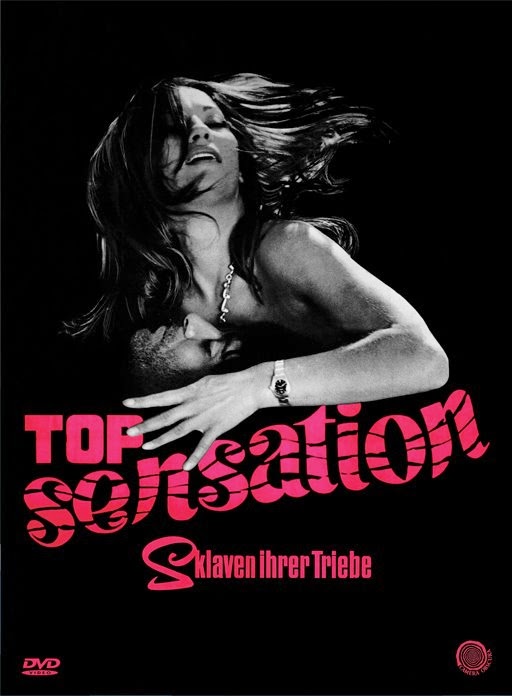
Top Sensation (1969)
It seems there are always new potentials to explore
with an isolated movie setting in a mansion, small villa, or castle, where a
number of situations with fixed conditions can arise, murders can go unnoticed,
and the sexually liberated can binge to their heart’s content. The peculiar sex
crime thriller Top Sensation (aka The Seducers) embraces the many
possibilities of the isolated story setting but does away with the more conventional
remote house and substitutes it with a private recreational yacht, setting most of the movie on the open sea. Cabins below deck are the lavish bedrooms,
the control room makes a nice study, and the poop deck is obviously the lounge,
for partying, adultery, and all other manner of fun nonsense.
Top Sensation was directed and written by Ottavio Alessi who has writing credits for some thirty-two movies, which include Dick Smart 2007 and Emmanuelle in America, but only two directing credits with Top Sensation being the last film he ever worked on as a director. The soundtrack, by Sante Maria Romitelli, consists of a melodic and epic sounding piece that could’ve come from a Spaghetti Western but does still manage to feel very welcome here and is extremely memorable.
A big selling point to this movie is the fact that it stars Edwige Fenech and Rosalba Neri. Both of these Eurocult goddesses in the same movie, in the same sex scenes together, is a big deal. Fenech hadn’t quite cemented her fame in several giallo films yet at the time the film was made, and so the fact that she and Neri were together in the same movie was probably incidental, but in retrospect it’s a glorious spectacle. However, after watching Top Sensation it should be apparent that this is not the film’s only credential.
Top Sensation was directed and written by Ottavio Alessi who has writing credits for some thirty-two movies, which include Dick Smart 2007 and Emmanuelle in America, but only two directing credits with Top Sensation being the last film he ever worked on as a director. The soundtrack, by Sante Maria Romitelli, consists of a melodic and epic sounding piece that could’ve come from a Spaghetti Western but does still manage to feel very welcome here and is extremely memorable.
A big selling point to this movie is the fact that it stars Edwige Fenech and Rosalba Neri. Both of these Eurocult goddesses in the same movie, in the same sex scenes together, is a big deal. Fenech hadn’t quite cemented her fame in several giallo films yet at the time the film was made, and so the fact that she and Neri were together in the same movie was probably incidental, but in retrospect it’s a glorious spectacle. However, after watching Top Sensation it should be apparent that this is not the film’s only credential.
Sunday, December 8, 2013
Alice / Neco z Alenky (1988)
I’m starting to realize I have a
weakness for filmmakers who have their own distinct style, the type I could
easily recognize even if I didn’t know what movie I was watching. After having a blast watching several of his
short films on YouTube, I became hooked on a lot of the inherent, and
consistent, characteristics of Czech surrealist animator Jan Svankmajer’s films. He’s a hero of sorts of the stop animation
technique, bringing inanimate objects like food and clay sculptures to life in
very perplexing ways. What really got me, after watching a particular short
film by Svankmajer, simply titled Food, was the way actual human actors
were utilized in stop motion sequencing, something known as pixilation, which
created a super strange reality, where people seemed to hover around and move like
androids, and eat like monsters. Of course, stop motion has quite often been
used by many filmmakers, but Svankmajer’s
surreal style tends to lead to pretty morbid and bizarre visuals that are also
amusing and humorous (the fourteen minute short Virile Games (1988) comes to mind).
After making short films for
twenty years, Jan Svankmajer made his
first full length movie, Alice,
inspired by Lewis Carroll’s novel Alice’s Adventures in Wonderland (1865),
a book that is supposedly for kids but still works for adult readers too,
especially ones still in touch with their inner child. The anthropomorphic
creatures of Carroll’s dreamland present
a perfect opportunity for Svankmajer to
create a unique vision with his distinct stop animation style. It’s also that
much creepier and a tad bit disturbing that most of
the creature models used were once living animals, like the skulls, the stuffed White Rabbit, or the barracuda head.
Just about everything we know from the
book is done with a different interpretation, here. Perhaps the simple title of
Alice is fitting enough, for her
dream doesn’t really feel quite like the Wonderland we all know. In this case,
the title Alice’s Adventures in
Wonderland could be modified to something more like “Alice’s Nightmares in
an Animator’s Workshop.”
Monday, November 18, 2013
Jess Franco's Count Dracula (1970)
As a kid, my earliest understanding of Count Dracula came
from The Monster Squad (1987), Count Chocula, Sesame Street, and a mythical final boss I could never get to in
the Nintendo game Castlevania 2: Simon’s
Quest. None of which was the proper way to get to know The Count, of course.
And so, I remained ignorant of the real legend of Count Dracula until fairly
recently when I was instilled with a desire to read Bram Stoker’s Dracula (1897),
following a pleasurably short read from Joseph
Sheridan Le Fanu’s Carmilla (1872).
Thanks to Stoker’s novel, I’ve been
on quite the Dracula kick lately, watching a lot of films based on the novel,
such as Nosferatu: A Symphony of Horror
(1922), Dracula (1931), Horror of Dracula (1958), Count Dracula (1970), Nosferatu: The Vampyre (1979), Bram Stoker’s Dracula (1992), and Dracula 3D (2012).
I really think we would’ve had a near-perfect adaptation with Francis Ford Coppola’s version from 1992, if it weren’t for the love story between Dracula and Mina thrown in, and I don’t think Lucy was supposed to seem so promiscuous, either. I’m actually not offended by a soft Dracula that could genuinely fall in love with a living woman without wishing her any harm; just don’t shoehorn it into an adaptation of Stoker’s novel. A lot of people who haven’t read the book will probably think it was a romance novel. I actually thought it was an interesting idea in Count Dracula’s Great Love (1974), where Paul Naschy created and portrayed, for the first time, Count Dracula as a romantic softie.
Thursday, October 31, 2013
Lord of Tears (2013)
Lord of Tears is the first co-production between Hex Media and Dark Dunes. It is an attempt at making a different type of horror film and revitalizing the classic, supernatural chiller style of the British Hammer horror that played an influence on Lord
of Tears director Lawrie Brewster.
It is also rich in Pagan influenced mythos, providing an avenue of research for
its protagonist, giving it a Lovecraftian feel.
Lord of Tears just recently (a few days ago) won two awards at the 2013 Bram Stoker International Film Festival: 1) The Audience Award and 2) Best Female Lead. My congratulations go out to the production, cast, and crew. I had a feeling it was going to be good, but Lord of Tears just turned out to be incredible.
The story concerns a school teacher's, Jamie's (Euan Douglas), vague nightmares and unsettling childhood memories and his drive to uncover the mystery behind these visions at his inherited estate. Despite a warning letter from his recently deceased mother, Flora (Nancy Joy Page), he’s driven back to his childhood house, which seems to be the site of a past traumatic incident for Jamie, one he does not seem to clearly remember. An entity seemingly related to his past trauma, a tall figure with long arms, the head of an owl, Victorian clothing, and intimidating talons, manifests at times in front of Jamie. As nightmares take further hold on him, he begins to wonder if he’s gone mad. All isn’t entirely bad, though, thanks to a young, lovely lady employed in the area, Evie (Lexy Hulme), who Jamie starts feeling a romantic connection to as she aids him in uncovering the mystery behind the Baldurrock House.
Lord of Tears just recently (a few days ago) won two awards at the 2013 Bram Stoker International Film Festival: 1) The Audience Award and 2) Best Female Lead. My congratulations go out to the production, cast, and crew. I had a feeling it was going to be good, but Lord of Tears just turned out to be incredible.
The story concerns a school teacher's, Jamie's (Euan Douglas), vague nightmares and unsettling childhood memories and his drive to uncover the mystery behind these visions at his inherited estate. Despite a warning letter from his recently deceased mother, Flora (Nancy Joy Page), he’s driven back to his childhood house, which seems to be the site of a past traumatic incident for Jamie, one he does not seem to clearly remember. An entity seemingly related to his past trauma, a tall figure with long arms, the head of an owl, Victorian clothing, and intimidating talons, manifests at times in front of Jamie. As nightmares take further hold on him, he begins to wonder if he’s gone mad. All isn’t entirely bad, though, thanks to a young, lovely lady employed in the area, Evie (Lexy Hulme), who Jamie starts feeling a romantic connection to as she aids him in uncovering the mystery behind the Baldurrock House.
Sunday, October 13, 2013
Cthulhu (2007)
Cthulhu
probably stands as one of the more controversial attempts at bringing the Cthulhu
mythos to the screen, exploring certain themes completely absent from H.P. Lovecraft’s
fictional writing. It’s a totally modern take on the novella The Shadow over Innsmouth that, at its
core, still ends up feeling like a very true embodiment of Lovecraft horror.
Taking
the more suggestive and indescribable approach, not much is seen yet much is insinuated.
Hearing the radio news reporting on wild polar bears going extinct and
the oceans rising, amongst others, suggests a kind of world that is falling
apart, an uneasy feeling of an approaching end. Blending this with an emphasis
on a beautiful but ominous dark ocean, it really feels like Cthulhu might be
rising very soon and the Old Ones will be claiming what is rightfully theirs. The East Coast New England settings fans of the author are more in tune with have
been transferred over to the West Coast in Astoria Oregon, and the setting is
an interesting and fitting shift that doesn’t feel disagreeable at all. There’s
just something about seaside towns that work so well for the Lovecraft sensibility. Why, after all, cannot
the Old Ones haunt a port town on the other side of the country?
Subscribe to:
Posts (Atom)