Thursday, May 15, 2014

The Other Side of the Mirror / Al otro lado del espejo (1973)

Jess Franco could film movies faster than I can write reviews for them. His films can sometimes have an overwhelming low quality feel to them, making them difficult to digest for the majority. The natural location shots, haunting tone, memorable and well-chosen female actors (Franco definitely had an eye for female leads that just seemed to resonate with the camera lens), and Franco’s brand of bizarre surrealism and eroticism don’t seem to be enough to save the films for many, but they are nonetheless a huge hit for others. Al otro lado del espejo contains all of the aforementioned elements and yet has a higher-than-usual quality feel to it, most likely due to the terrific acting and screen presence from its leading lady (Emma Cohen of Horror Rises from the Tomb and Night of the Walking Dead) and a believable tragic story.

Jazz pianist/singer Ana (Cohen) is profoundly affected by her father’s (Howard Vernon) suicide shortly after her engagement. After calling off the wedding, Ana leaves her homeland on Madeira Island only to undergo several failed relations when she intermittently becomes hypnotically driven to kill any man that becomes close to her.

It isn’t just enough to say that Ana is haunted by images of her dead father in the mirror. She doesn’t just see him, but she finds herself at times in the mirror, in Franco’s looking glass world. It can also be viewed as Ana’s mental reflection on her emotional trauma. The memory of her father’s suicide driven by his stubborn disapproval of her marrying and leaving him is intertwined with Ana’s psyche, manifesting itself when she murders any man that shows any sexual interest in her. Ana’s traumatization, spurned the moment of her outcry into the mirror, yields a malediction that could either be viewed as some sort of curse or spell from her father’s ghost or played off as the result of a kind of posttraumatic stress disorder. If taken at face value, the goose bumps inducing ending, made more dramatic with church bells signifying the wedding that never was, reveals which one happens to be the case.

Monday, April 21, 2014

Down to the Cellar / Do pivnice (1983)

Down to the Cellar is a short film from Czech filmmaker Jan Svankmajer that I’ve grown fond of. I remember feeling a little underwhelmed when I first watched it, but it stayed with me, for some reason, and now it’s one of my favorite short films (I wonder if there’s a name for that kind of art). It was the same with Svankmajer’s Alice (Neco Z Alenky), a creepy vision of Lewis Carroll’s Alice in Wonderland complete with Svankmajer’s disturbing but fascinating characteristics. For me, the last quarter of Alice became a battle to stay awake. I thought Alice just wasn’t the film for me, but that couldn’t have been more untrue. Alice ended up planting itself in my mind before slowly taking its hold on me, and, as if a bug had just bit me, I spontaneously ordered off for the DVD and, on a whim, read for the first time Alice’s Adventures in Wonderland and Through the Looking Glass. As those of you that follow my At the Mansion of Madness fan page on Facebook might have noticed, I have endeavored to watch as many AIW movies as I can slowly but surely come across. This is all primarily thanks to Jan Svankmajer’s vision of AIW. Not bad for a movie that I struggled to stay awake during on first viewing.

Monday, April 7, 2014

Morgiana (1972)

Morgiana, by Slovak director Juraj Herz, is a seldom spoken of curio from the Czechoslovak New Wave that’s heavily stylized with regards to its visuals and mood but is straightforward with its story and might feel a little influenced by the ‘Grand Dame Guignol’ horror of What Ever Happened to Baby Jane?. Much like Poe’s The Black Cat, there is an escalating sense of guilt in its protagonist, aristocratic villainess Viktorie (Iva Janzurová), that’s not particularly out of remorse or regret for her crime, but from paranoia, constant annoying reminders of her misdeed, and fear of being found out, which is where I think a lot of the suspense comes from.

I like that there is a lot of appeal to its detestable, unsympathetic villain. Viktorie (Viki) is probably one of my new favorite villains. She emanates a wicked aura, primarily due to her excessively evil gothic look that pretty much gives away the nature of her game at first glance. Janzurová's performance is frightening, stellar, and versatile. I say versatile because she also plays Viki’s sister, Klára. The personalities and appearances between the sisters are like night and day, and I don’t know if I was a bit naïve at the time, but after watching the whole movie for the first time, I had no idea the same actress played both sisters.

Monday, March 10, 2014

Sex of the Witch (1973)

Witchcraft, tainted family history, and murder mysteries are very agreeable story themes, but writer and director Angelo Pannaccio, hitherto unknown to me, gives these horror hallmarks an attractively perverse edge with Sex of the Witch.

This is one of those films that brings a substantially large group of shady relatives together in a family mansion for the reading of a will, with the inheritance being split equally among the relatives, with an added stipulation that if any beneficiary should die before a certain time, their share must be split among the surviving heirs. Of course this will inevitably create a murderer or two, amongst the family. I’ve seen a similar plot device in a couple other movies, One Body Too Many and Legacy of Blood, but something different with Sex of the Witch is the inclusion of a perverse, evil witch relative with a good measure of hate and malice for the family, which gives what could’ve been a routine plot device a rather demented and supernatural spin.

Monday, February 17, 2014

Love and Death in the Garden of the Gods (1972)

Being a conversation heavy drama mystery with a bit of a dreamy languor about it, Love and Death in the Garden of the Gods may require a little focus from viewers if they hope to get absorbed in its compelling story, beautiful scenery, and tragic characters, but it is worth it. The plot is more or less structured to be an exploration of a hazy backstory that slowly crystalizes before eventually catching up with the present.

The film is directed by Sauro Scavolini, a prolific screenwriter (All the Colors of the Dark, amongst many others) with few directing credits. He is the brother of director Romano Scavolini (Nightmares in a Damaged Brain), who also helmed cinematography for Love and Death in the Garden of the Gods.

The story is fed to us in fragmented bits and pieces from an inquisitive Professor of ornithology (Franz von Treuberg), restoring and listening to a heap of tangled audio recording tape he discovered in the forest outside the villa he’s rented to study the non-indigenous birds of the region. As the Professor listens to the tape recordings, the film cuts to flashbacks of the previous inhabitants of the villa, making the place seem haunted by a past that is both alarming and fascinating. While the past is the primary setting of the story, the film still emphases events in the present, particularly the relation between the professor and the seedy estate administrator, Dominici (Vittorio Duse), giving the Professor dimension and making him more than just an avenue of backstory disclosure.

Saturday, January 25, 2014

Delirium / Delirio caldo (1972)

At first glance, Renato Polselli’s stylistic S&M fever nightmare, Delirium, might feel like an interesting case study of psychopathy, but I’m hesitant to call the film’s protagonist a psychopath. He’s definitely a sadistic maniac of sorts, but a psychopath has no conscience and therefore cannot feel empathy and remorse. Our maniac, here, feels remorse and is at odds with himself. After doing harm, he gets emotional and curses his reflection before shattering the mirror. Just to stop the monster, he tries to set himself up to be caught by the police.

No sir, he may be a serial killer, but the highly respected, criminal psychologist and police consultant Dr. Herbert Lyutak (Mickey Hargitay) is no psychopath.

He actually makes for a compelling lead, thanks to a fair amount of charisma and outward charm that contrasts with his hidden sick side. It’s made known early on that Herbert’s a particularly nasty fellow, with a pitch black disturbing murder sequence involving a young lady (Stefania Fassio). In making its protagonist a murderer, we have something more unique from the get go. Though we know Herbert’s a killer, murders still continue in the traditional ‘whodunit’ giallo style, which imposes the question of Herbert being the only killer. The multiple murder scenes of pretty girls getting killed are cruel, which isn’t surprising for a giallo, but Polselli really seems to be trying to outdo them all.

Sunday, December 29, 2013

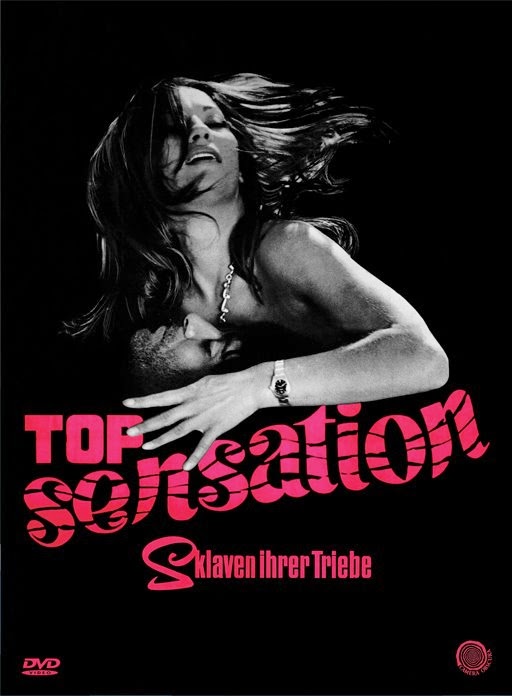
Top Sensation (1969)

It seems there are always new potentials to explore with an isolated movie setting in a mansion, small villa, or castle, where a number of situations with fixed conditions can arise, murders can go unnoticed, and the sexually liberated can binge to their heart’s content. The peculiar sex crime thriller Top Sensation (aka The Seducers) embraces the many possibilities of the isolated story setting but does away with the more conventional remote house and substitutes it with a private recreational yacht, setting most of the movie on the open sea. Cabins below deck are the lavish bedrooms, the control room makes a nice study, and the poop deck is obviously the lounge, for partying, adultery, and all other manner of fun nonsense.

Top Sensation was directed and written by Ottavio Alessi who has writing credits for some thirty-two movies, which include Dick Smart 2007 and Emmanuelle in America, but only two directing credits with Top Sensation being the last film he ever worked on as a director. The soundtrack, by Sante Maria Romitelli, consists of a melodic and epic sounding piece that could’ve come from a Spaghetti Western but does still manage to feel very welcome here and is extremely memorable.

A big selling point to this movie is the fact that it stars Edwige Fenech and Rosalba Neri. Both of these Eurocult goddesses in the same movie, in the same sex scenes together, is a big deal. Fenech hadn’t quite cemented her fame in several giallo films yet at the time the film was made, and so the fact that she and Neri were together in the same movie was probably incidental, but in retrospect it’s a glorious spectacle. However, after watching Top Sensation it should be apparent that this is not the film’s only credential.

Sunday, December 8, 2013

Alice / Neco z Alenky (1988)

I’m starting to realize I have a weakness for filmmakers who have their own distinct style, the type I could easily recognize even if I didn’t know what movie I was watching.  After having a blast watching several of his short films on YouTube, I became hooked on a lot of the inherent, and consistent, characteristics of Czech surrealist animator Jan Svankmajer’s films. He’s a hero of sorts of the stop animation technique, bringing inanimate objects like food and clay sculptures to life in very perplexing ways. What really got me, after watching a particular short film by Svankmajer, simply titled Food, was the way actual human actors were utilized in stop motion sequencing, something known as pixilation, which created a super strange reality, where people seemed to hover around and move like androids, and eat like monsters. Of course, stop motion has quite often been used by many filmmakers, but Svankmajer’s surreal style tends to lead to pretty morbid and bizarre visuals that are also amusing and humorous (the fourteen minute short Virile Games (1988) comes to mind).

After making short films for twenty years, Jan Svankmajer made his first full length movie, Alice, inspired by Lewis Carroll’s novel Alice’s Adventures in Wonderland (1865), a book that is supposedly for kids but still works for adult readers too, especially ones still in touch with their inner child. The anthropomorphic creatures of Carroll’s dreamland present a perfect opportunity for Svankmajer to create a unique vision with his distinct stop animation style. It’s also that much creepier and a tad bit disturbing that most of the creature models used were once living animals, like the skulls, the stuffed White Rabbit, or the barracuda head.

Just about everything we know from the book is done with a different interpretation, here. Perhaps the simple title of Alice is fitting enough, for her dream doesn’t really feel quite like the Wonderland we all know. In this case, the title Alice’s Adventures in Wonderland could be modified to something more like “Alice’s Nightmares in an Animator’s Workshop.”