Showing posts with label Rosalba Neri. Show all posts

Sunday, April 3, 2022

The Devil’s Lover / L’amante del demonio (1972)

Now I have you with me, under my power. Our love grows stronger now with every hour. Look into my eyes, you will see who I am. My name is Lucifer, please take my hand.” – Black Sabbath 

When Satan comes to town, he sets his sights on the biggest catch in The Devil’s Lover, or my personal favorite alternate title Lucifera: Demonlover

I don’t know why, but it’s taken me many years to revisit this Italian gothic horror. The last time I watched it was in 2009 when I picked up the pan-and-scan Mya DVD. Despite the poor picture quality, I was happy to have it, as I probably wouldn’t have ended up knowing about it otherwise, but I am surprised the film never had an upgrade since. As far as I can tell, the only way to see it in 2022 is still as a censored and murky full screen film [Update (December 2023): Severin has released this film on Blu-ray uncut and restored in Volume 2 of their amazing Danza Macabre Italian gothic horror boxsets]

Even though it was restrained, my fondest memory of this film was the grand love scene between a nude Rosalba Neri and a clothed, caped Devil figure, played by Edmund Purdom. I was in awe at the visual of Rosalba’s sideways lying profile figure that was partially shrouded by the devil’s cape as he embraced her. It certainly has the same kind of energy as the classic reclining nude paintings, such as La Grande Odalisque (1814) by Jean-Auguste-Dominique Ingres or The Rokeby Venus (1647-1651) by Diego Velázquez.

Thursday, February 23, 2017

The Devil’s Wedding Night / Il plenilunio delle vergini (1973)

For me, The Devil’s Wedding Night is kind of like a Dracula movie but with Rosalba Neri playing Dracula, which is just a prepossessing idea. However, that’s not quite what it is, as it plays more like a spinoff, fanfic, or sequel to Dracula, where Count Dracula is the stuff of legend, with his power being the focus of archeological research. It’s interesting that in the film’s story Edgar Allan Poe seems to be an upcoming new sensation, which sets it around the first half of the 19th century, making it predate the events in Bram Stoker’s novel that occur around the 1890s. So, The Devil’s Wedding Night could actually be a prequel to Dracula. I mean, who was that mysterious smirking man in the woods, at the tavern, and on the castle grounds we kept seeing? The mysterious man is a nice touch who’s most likely a servant to the ring, but there’s nothing ruling out that he could have been Dracula the whole time, perhaps a powerless Dracula who needs the black mass wedding ceremony to be reborn.

Sunday, July 27, 2014

Asylum Erotica / Slaughter Hotel (1971)

I was charmed the other day by a 1915 vintage, almost Victorian looking, Kellogg’s Corn Flakes advertisement poster I spotted amongst the old-fashioned-decor adorned on the walls at a local Cracker Barrel diner. While staring at the ad, for some reason, I became curious as to the origin of Corn Flakes. Where were they invented, and how did they come about? I previously had a stereotypical notion that they may have originated in farming communities, due to the rooster, Cornelius, usually observed on the boxes. After ordering pancakes, I googled “Kellogg’s Corn Flakes history” on my phone, and the results were a little startling.

It appears the invention that brought about Corn Flakes was discovered by accident in 1894, at the Battle Creek Sanitarium in Michigan by health reformist Dr. John Harvey Kellogg and his brother Will Keith Kellogg as part of a bland diet to keep the patients from having increased passions, i.e. to keep them from masturbating.

One day, the Kellogg brothers left a batch of cooked wheat out to sit, when they were diverted by urgent matters at the sanitarium. Upon their return, they’d found that the wheat had gone stale, but because they were under a strict budget, they decided to salvage the wheat. After pressing the wheat through rollers, it formed, to their surprise, wheat flakes that were subsequently toasted and served to the patients; it ended up being a hit. Later Will Keith Kellogg experimented with flaking corn, which he eventually made into a successful business.

Dr. John Harvey Kellogg was a pioneer surgeon, who succeeded in having exceptionally low mortality rates with his surgery practice. He was the superintendent of the Battle Creek Sanitarium and pioneered numerous health reform treatments, some of which still hold up today. However, the good doctor sometimes missed the mark.

Thursday, June 5, 2014

Lady Frankenstein (1971)

Lightning, angry mobs, grave robbing, and a criminal’s brain, like so many Frankenstein offshoots / spinoffs / parodies, Lady Frankenstein owes more to James Whale’s classic 1931 horror film than Mary Shelley’s 1818 literary masterpiece. Despite its many fitting references to, and retreading to an extent, some of the plot points to its trendsetting predecessor, Lady Frankenstein is far from feeling like a gory, colored remake, primarily thanks to the addition of Frankenstein’s biological daughter, Tania (Rosalba Neri), a little novelty with a lot of potential, like reimagining the classic 1931 movie with the doctor’s attractive but even more ambitious daughter written into the story.

In a time when females were grossly underrepresented in science, Tania Frankenstein shatters what must’ve been a prominent stereotype, enduring her pursuit as a surgeon, even when faced with sexist instructors at the University; as she puts it, “the professors have a lot of old fashioned ideas about a woman’s place.” When she returns home from the University after becoming a licensed surgeon, her father, Baron Frankenstein (Joseph Cotten), expresses admiration for her accomplishments, and yet he and his assistant, Dr. Charles Marshall (Paul Müller), still treat her as if their work involving cadavers is too much for her delicate senses to fathom. They seem to not want to involve her in their gruesome work, but, to their surprise, she’s all for it. They attempt to make her think they are working with animals, but she has been thinking along the same lines as her father the entire time, being more interested in human transplants; “I am my father’s daughter.” Not only does she thoroughly understand her father’s work, she ends up refining it.

Sunday, December 29, 2013

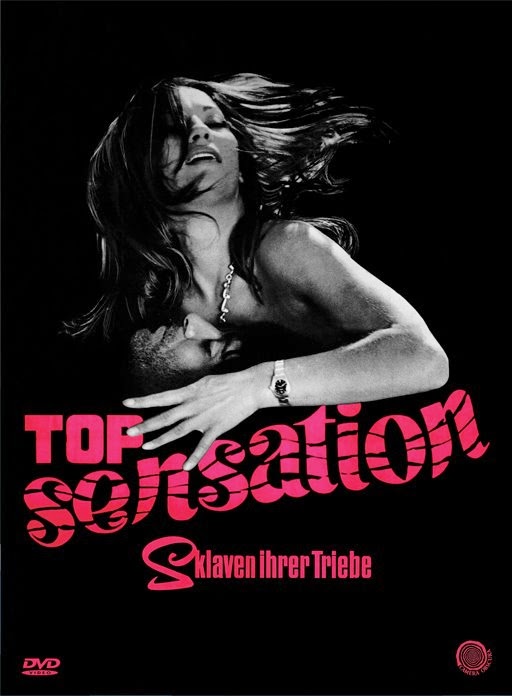
Top Sensation (1969)

It seems there are always new potentials to explore with an isolated movie setting in a mansion, small villa, or castle, where a number of situations with fixed conditions can arise, murders can go unnoticed, and the sexually liberated can binge to their heart’s content. The peculiar sex crime thriller Top Sensation (aka The Seducers) embraces the many possibilities of the isolated story setting but does away with the more conventional remote house and substitutes it with a private recreational yacht, setting most of the movie on the open sea. Cabins below deck are the lavish bedrooms, the control room makes a nice study, and the poop deck is obviously the lounge, for partying, adultery, and all other manner of fun nonsense.

Top Sensation was directed and written by Ottavio Alessi who has writing credits for some thirty-two movies, which include Dick Smart 2007 and Emmanuelle in America, but only two directing credits with Top Sensation being the last film he ever worked on as a director. The soundtrack, by Sante Maria Romitelli, consists of a melodic and epic sounding piece that could’ve come from a Spaghetti Western but does still manage to feel very welcome here and is extremely memorable.

A big selling point to this movie is the fact that it stars Edwige Fenech and Rosalba Neri. Both of these Eurocult goddesses in the same movie, in the same sex scenes together, is a big deal. Fenech hadn’t quite cemented her fame in several giallo films yet at the time the film was made, and so the fact that she and Neri were together in the same movie was probably incidental, but in retrospect it’s a glorious spectacle. However, after watching Top Sensation it should be apparent that this is not the film’s only credential.