Monday, September 24, 2012

The Sect / La setta (1991)

Beautiful dreams turn into pulse pounding nightmares in Michele Soavi’s highly intricate cult-conspiracy masterpiece, THE SECT (aka THE DEVIL'S DAUGHTER).  

Soavi is the type of director that seems to make every movie as if it was his last, taking the chance to squeeze in as many ideas, symbolism, and set pieces as possible. The result is eclectic and convoluted but also spellbinding, as in THE SECT and CEMETERY MAN, with the former being the more ominous and downbeat of the two, likely the result of everyone working to appease the boss-man, Dario Argento

Part of the reason for the intricacy is because THE SECT is a product of three different writers, Argento, Soavi, and Gianni Romoli,* all of whom seemed to have their own visions. The production of the movie started with a screenplay for an unrealized movie called CATACOMBS by Romoli, and Argento took it and added his input, which included references to The Rolling Stones (he’s a huge fan).* Soavi further incorporated a script from an unrealized movie of his, THE WELL, and layered it with esotericism and Celtic symbolism, and the seemingly independent ideas from three different heads was further refined and finalized by Romoli* into one hellava movie.

Nevertheless, the convoluted nature of the film has harmed it for a large fraction of viewers, making it difficult to follow and giving it an underlining annoyance that the movie may not be going anywhere. Therefore, the recommended way to view this is to just concern oneself with what is taking place at hand without worrying about where the story is leading to. It’s best to enjoy the individual segments for what they’re worth, and being that there’s a lot of gold here, they’re worth a lot.

Monday, September 10, 2012

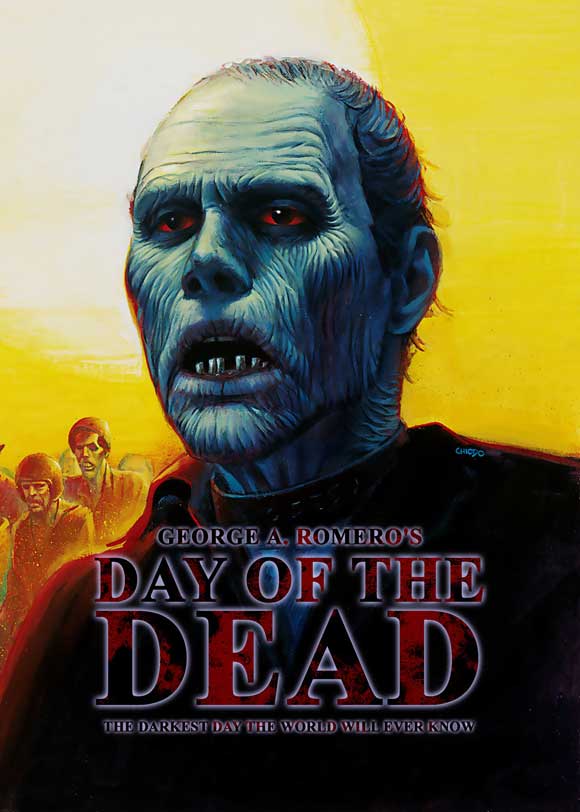
Day of the Dead (1985)


My contribution to Month of the living Dead over at Blood Sucking Geek is an article for my favorite zombie film. Head over to read what I have to say about it, and be sure get in on all of the zombie fun that’s taking place this month.

Friday, August 31, 2012

The Ghost / Lo spettro (1963)

‘Epic’ has sort of become a popular internet slang term these days and is generally used as a descriptive response for anything that comes off as grandly awesome. I normally prefer using it in the more traditional sense as a tag for a long story that spans multiple books or movies. So, even given its standard runtime, why is ‘epic’ the first adjective that comes to mind when thinking about Riccardo Freda’s generically titled Gothic horror/mystery THE GHOST?

In trying to come up with a possible answer, I find myself realizing just how well nearly everything about THE GHOST hits the spot. From the opening séance to the fulfilling ending, there ends up being a very attractive mental journey, dense with macabre elements, to a destination that could only be described as maniacal insanity, just before the film closes out with a religious representative reminding us that the devil is a very real person. I feel that it is this cadaverous journey, mostly within the confines of a richly decorated Scottish 1910 mansion as well as the grand supernatural, alien beauty of the film’s star, Barbara Steele, that merits the ‘epic’ tag.

Am I right when I say that Steele was an essential component in helping several Italian Gothics rise above being standard genre fare? Just like the chorus to a particular ‘80s Roxette song, she’s got the look. Here, Steele doesn’t portray her usual dual role of a good and an evil character but only the latter in this film, and it really is what she does best. She’s on fire in an immortal murder scene late in the movie that brings to mind the phrase ‘slashed to ribbons’. 

Sunday, August 12, 2012

The Whisperer in Darkness (2011)

THE WHISPERER IN DARKNESS is one of the creepier and tenser short stories from H.P. Lovecraft. Readers are given enough hints to know all too well that something bad is going on as the story’s protagonist, despite his academic intelligence, seems too clueless and too stubbornly grounded in his notion of the realistic world to realize that he’s heading to a perilous destination. Journeying along with this character, Professor Albert Wilmarth, into an unnatural and creepy situation written in a first person perspective is largely what I think makes this short story work so well. In the first half there’s a lot of tension that is built up from the letter exchange correspondence between Albert and another character, Henry Akeley, whose farm is seemingly being invaded by alien monsters. However, nothing really ends up being truly conclusive with a lot being left to suggestion or just being the possible result of some weird and unexplainable phenomena or coincidences.

While I don’t think that it reaches the same high tension found in Lovecraft’s original story, the film adaptation by The H.P. Lovecraft Historical Society (HPLHS) does an exceptional job at taking the liberty of filling in a lot of blanks by rounding out the story with much more definite events and including a third act that contains some new surprises that don’t disgrace the original story in the least. Though the narrative is understandably tweaked a bit to be more suitable for film, this still feels like one of the most faithful and near-perfect Lovecraft adaptations since the HPLHS’s CALL OF CTHULHU from 2005, though I honestly enjoyed THE WHISPERER IN DARKNESS a bit more.

Wednesday, July 25, 2012

Venomous Vixens: Kali Hansa

Kali Hansa, born Marisol Hernández, sort of put a spell on me with her role as Tunika in Amando de Ossorio’s THE NIGHT OF THE SORCERERS. I would have dreams that were kind of like my own imagined sequel to the film, where, in a sickly state, I would travel to the African forest where this film took place. Knowing my time was running short, due to some sort of terminal illness, I would travel up a mountain and to a place where I knew I would find Tunika, in her vampire form. Longing to end my suffering, I would find her in a shallow moonlit river where she would welcome me, and through an act of vampiric intercourse, she would make me like her, curing me, making me immortal, and also inflicting her curse upon me. 

Thus is the effect her presence in THE NIGHT OF THE SORCERERS had on me. With her constantly lingering in my mind, I eventually viewed several more films that she was in, sometimes credited as Gaby Herman or Kali Hansen. I was slightly saddened to find out that she was usually just a supporting/minor character and had an acting career that didn’t really take off, and it seemed to have ended circa 1976 after shooting a hardcore porno for Jess Franco, WHITE SKIN BLACK THIGHS and an erotic comedy, GIRLS IN THE NIGHT TRAFFIC. Despite usually having small roles and frequently being killed off, she visually stood out the most amongst other characters and gave off an ‘Oh-wow, who’s-that?’ impression. She apparently vanished after filming her last movie. She is from Cuba and was the girlfriend of Alberto Dalbes.

(Rumor bin: According to Jess Franco she moved back to Cuba to use her exceptional strength to fight against Fidel Castro!!!

For this tribute to Kali Hansa, and possibly a new series for AT THE MANSION OF MADNESS (Venomous Vixens), I’ve organized a few thoughts and images from a selection of some of her films.

Wednesday, July 11, 2012

Get Well Soon (2011)


This odd but satisfying psychological horror short is an interesting and nightmarish look at the deterioration of the marriage between its two sole characters, Theodore and Janet (Gresby Nash and Laura Howard). With its claustrophobic home interior setting, the film maintains a consistent tone as we witness a sort of aftermath to Theodore’s bout with breast cancer, now in remission. Contrary to what should be a good thing, the story takes a more downbeat approach as things seem fairly depressing, instead, with the couple apparently growing distant after Janet discovers she is pregnant. Being disappointed by her pregnancy causes Janet to realize that she truly isn’t happy with her marriage anymore, and so she decides to keep the pregnancy from her husband. The idea of feeling trapped is brought out remarkably well with Janet locking herself in the bathroom as a way of escape.


Theodore learns of the pregnancy after overhearing Janet talking on the phone to a friend. It ends up being real hard on him to know that Janet is deliberately keeping the news about their child from him. As events unfold in a days-of-the-week progression, he undergoes a kind of mental degradation. With the cinematography on display during Theodore’s decline, I could almost feel his inebriation when he starts to go heavy on the drugs and alcohol. The horror elements of the film start to come out more as the problem escalates and reality and nightmare start to merge.


GET WELL SOON showcases terrific performances from its two sole actors (I especially loved the chilling way that Laura Howard abruptly switched her facial expression during a key moment that involves her screaming at something off camera). The story by Michael Woodman is engaging and well written, though some viewers might end up with some unanswered questions (being a psychological horror film this is understandable, but I’m interested in knowing if the consistent use of the bathtub symbolized or meant anything). My favorite part consists of an artistically shot nightmare scene that portrays the cause of Theodore’s drug consumption and the effect that this new ordeal is having on him -- a disturbing visual of Theodore resting on Janet’s bosom as she envelops him and feeds him pills. I also enjoyed getting freaked out by the movie’s ending scene, which caused GET WELL SOON to impress me more than I was expecting. It is genuinely scary, and I admire the way Woodman decided to avoid having a predictable ‘guy goes crazy and kills his wife’ ending.

Get Well Soon: Full Movie (14 min and 3 sec)

Saturday, June 23, 2012

The Virgin of Nuremberg (1963)

Thinking outside of the box can be a tricky task, but it is necessary if one hopes to come up with a story that hasn’t already been thought of or isn’t something that could just as easily be dreamt up by anybody. The natural habit of falling into a comfort zone can easily hamper one’s ability to innovate. In the context of genre film, it is easy to stay inside the comfort zone while exploring around a little outside of the box, not too far, though, to discover something pretty new and cool that keeps the genre alive for that much longer. With Antonio Margheriti’s THE VIRGIN OF NUREMBERG we have all of the ‘60s Gothic horror themes we know and love that keep us happy and comfortable but melds and fuses them with fascinating new approaches that keeps one from getting bored of the same ol’, same ol’. 

A young nobleman moves into his ancestral castle with his wife. After the wife notices her husband missing one night, she strolls out of bed and seemingly witnesses the aftermath of a servant being tortured and murdered in the castle’s museum of medieval torture devices. The person responsible is a ghostly killer whose identity is hinted at by a servant that refers to him as “The Punisher,” claiming that he’s come back “to plant the seed of terror in shameless women’s hearts.” Is the killer her husband, one of the strange servants, or something else that has culminated from past evils?

A cool little charm to Margheriti’s film is that despite a few reminders of the modern (1960s Germany) setting, the majority of time spent in and around an ancient castle frequently fooled me into thinking that this was an era piece. I liked that there were plenty of candles with antique holders on hand for when the mandatory thunderstorms would cause the power to go out, giving us a nice reason to view our gorgeous heroine, Mary (Rossana Podestà of SEVEN GOLDEN MEN), wander the dark castle halls with lit candles in hand.

Monday, June 4, 2012

She Killed in Ecstasy (1970)

What decides when to move forward with experimentation that may be considered unethical or taboo but could better humanity? Debates on the ethics and consequences of the research are usually conducted. But what of the consequences of the idea being turned down? One possible answer to this is provided in Jess Franco’s SHE KILLED IN ECSTASY, where a physician, who believes his experiments hold the key to making humanity far more resistant to disease, is condemned, on moral grounds, by his colleagues, insulted and has to endure his precious documents being ripped and thrown aside.
   
With Jess Franco, I don’t necessarily think it's a simple matter of taste but more a matter of acquired taste. I mentioned a while back in my write-up for A VIRGIN AMONG THE LIVING DEAD that I wasn’t too impressed with Franco at first. In fact, I started watching his movies just to see if they are as bad as some people say they are. But the impulse to continue to explore his works stayed with me, and I’m glad I didn’t lose interest, otherwise, I really would’ve missed out on some gems, like this one.

A married couple lives a blissfully happy existence together, until the husband’s controversial research on human embryos results in him being expelled from his occupation by the medical association. He is driven to suicide, and his wife swears revenge on those she believes to be responsible.

This story contains no real surprises, and it ends up being easy to see where everything is going, and so, it instead becomes more important that we at least enjoy our time in the world that the film creates for us and the company of its lead character. The pleasant company in SHE KILLED IN ECSTASY is Soledad Miranda, who I’d like to describe as being like a fragile doll with enticingly dark features and doughy eyes that stare seductively. In a room full of people, she stands out like a beautiful black rose in a garden of weeds.