French actress Mireille
Dargent acted in six movies, four of which were for
director Jean Rollin. The one she’s
most known for is a Rollin film where
her presence reverberated inside my memory, ever since I saw it. This film is Requiem for a Vampire, where the sultry
redhead appears alongside one-half of the Castel
twins, Marie-Pierre Castel. The two actresses
play a couple of inseparable lovers, who after escaping some sort of crime heist,
curiously dressed as clowns, eventually find themselves in vampire territory. Interestingly
enough, we are introduced to this clown couple and their male companion at the
start of the film in a high speed chase with guns blazing. After losing their
pursuers, their male companion passes away, not surviving his gunshot wound. The two clowns, named
Michelle (Dargent) and Marie (Castel), set fire to their car, with the deceased’s body inside of it, before travelling off on foot and on
their own. When they wash off the paint and lose their clown getup, it’s
revealed, not surprisingly, that there were a couple of attractive girls
underneath the clown makeup.
Wednesday, November 28, 2012
Sunday, November 11, 2012
The Reincarnation of Isabel (1973)
If ever there was a movie that epitomized the weird,
scattered, and strangely erotic nature of Eurohorror the most, that film would
most likely be The Reincarnation of
Isabel. It’s a work of art where a clear goal-driven narrative seems to
have either been purposefully or unknowingly neglected. It’s still a good
story but one that is awkwardly told. It may just as well have been that
having a story spoon-fed to viewers was of little importance in this case, as director
Renato Polselli (Delirium, The Vampire and the Ballerina) might’ve felt he had a lot
more to offer by instead unloading his tale of reincarnation in a rather
erratic fashion, frequently diverging from the narrative for the sake of
overusing the film’s seductive set pieces, with events happening for unclear
reasons and moving in unclear directions. It is also nonetheless done with
gusto and a unique painterly craftsmanship. Fans of the weird and sexy side of
Eurohorror should consider looking to The
Reincarnation of Isabel to get their regular fix.
A supposed witch, Isabella (Rita, Nude for Satan, Calderoni), was staked and burned at an altar in front of an attentive mob of villagers. Centuries later, someone or something with a following of cultists and vampires is trying to revive/reincarnate the Great Mistress, Isabella, and they’ll sacrifice as many virgins as it takes for her to live again. Women are turning up dead with their hearts missing and strange bite marks on their necks. It all seems to be connected to a castle that has just been bought and occupied by a Mr. Jack Nelson (Mickey, Bloody Pit of Horror, Hargitay), his wife, and his stepdaughter, Laureen (also played by Calderoni). A special party in celebration of Laureen’s engagement to a local man is underway in the castle, and the epoch involving Isabella’s persecution in the long distant past begins to haunt the inhabitants in erotically bizarre and deadly ways.
What can I say about Rita Calderoni? She’s a delightful and committed lead with very pure good looks. Interestingly enough like in the film Nude for Satan, there are moments where she inexplicably has a single breast exposed without seeming to notice or care that her boob is showing. Seeing her treat us to this provocative sight of her in more than one movie has caused me to consider this look to be her trademark. Calderoni also puts on a convincing performance with her portrayal of the persecuted Isabel. She looks like she went through a lot for us, and it actually looks like it hurts when they drive a stake through her.
A supposed witch, Isabella (Rita, Nude for Satan, Calderoni), was staked and burned at an altar in front of an attentive mob of villagers. Centuries later, someone or something with a following of cultists and vampires is trying to revive/reincarnate the Great Mistress, Isabella, and they’ll sacrifice as many virgins as it takes for her to live again. Women are turning up dead with their hearts missing and strange bite marks on their necks. It all seems to be connected to a castle that has just been bought and occupied by a Mr. Jack Nelson (Mickey, Bloody Pit of Horror, Hargitay), his wife, and his stepdaughter, Laureen (also played by Calderoni). A special party in celebration of Laureen’s engagement to a local man is underway in the castle, and the epoch involving Isabella’s persecution in the long distant past begins to haunt the inhabitants in erotically bizarre and deadly ways.
What can I say about Rita Calderoni? She’s a delightful and committed lead with very pure good looks. Interestingly enough like in the film Nude for Satan, there are moments where she inexplicably has a single breast exposed without seeming to notice or care that her boob is showing. Seeing her treat us to this provocative sight of her in more than one movie has caused me to consider this look to be her trademark. Calderoni also puts on a convincing performance with her portrayal of the persecuted Isabel. She looks like she went through a lot for us, and it actually looks like it hurts when they drive a stake through her.
Sunday, October 21, 2012
A Black Ribbon for Deborah (1974)
Marina
Malfatti is Deborah, a sterile woman who wants to bear a child
more than anything. She’s told by her doctor to give up all hope of having a
child; for in her condition it would take a miracle, and miracles don’t exist.
This condition is like a malediction to her, and it’s having a ruinous effect
on the marriage between her and her scientist husband, Michel (Bradford Dillman), who is earnestly
attempting to push for a happy marriage, but his wife’s occasional breakdowns
are sometimes too much for him. Deborah doesn’t seem to realize it, but she
also happens to be a very powerful medium, and after she and her husband investigate
a car accident they’ve just witnessed, Deborah has an encounter with a dying
pregnant woman, Mira (Delia Boccardo),
which sets the stage for a wholehearted and satisfying mystery.
Her short hairstyle here seems like an odd choice; it took me a while to get used to it, although the look grew on me and is something that I’ve come to readily identify her role in this film with. Being that a lot of these films were influenced by Rosemary’s Baby, the choice of hairstyle was likely to give her a Mia Farrow vibe.
I love genre
actresses like Edwige Fenech and Rosalba Neri, but I sometimes wonder:
what about Marina Malfatti? Sure, she
wasn’t as wildly sexual as her peers, but she still made for lovely company as
a supporting actress in films like All the Colors of the Dark and The Night
Evelyn Came out of the Grave. Until now I’ve never had the chance to view her
as a leading lady, and with A Black Ribbon for Deborah, Malfatti has the chance to prove
herself as the lead character, and she carries this eerie take on
parapsychology on her shoulders rather well.
Her short hairstyle here seems like an odd choice; it took me a while to get used to it, although the look grew on me and is something that I’ve come to readily identify her role in this film with. Being that a lot of these films were influenced by Rosemary’s Baby, the choice of hairstyle was likely to give her a Mia Farrow vibe.
Tuesday, October 16, 2012
Rochelle, Rochelle
Of all the fake movies referenced in several
Seinfeld episodes, one in particular Rochelle, Rochelle is one that actually
looks interesting to me. I usually get a chuckle from some of the silly fake
movie titles mentioned in the series like Checkmate, Sack Lunch, Chunnel, and
Prognosis Negative, but Rochelle, Rochelle appeals to the inner cult movie fan
in me, and I just can’t help wishing that the movie was real and directed by someone
like Jess Franco. The tagline: “A
young girl's strange, erotic journey from Milan to Minsk” reminds me of Franco’s Eugenie… the story of her journey into perversion, and it also brings to mind Joe
D’Amato’s Emanuelle Around the World. Could it be that the writers of
Seinfeld had these types of films in mind when coming up with the Rochelle,
Rochelle gag? In the series, the movie is referred to as foreign and apparently
generated a lot of hype, but the general response ended up being that the plot
was unbearable, and it was just the nudity that made it revered. Now I
absolutely love this kind of stuff (especially if there are horror elements
fused in), so you usually won’t find me making such remarks.
What do you think? Is there more to most foreign erotic movies than just the sex and nudity?
Labels:
Erotic,
Jess Franco,
Joe D'Amato,
Movie Posters,
Seinfeld
Monday, September 24, 2012
The Sect / La setta (1991)
Beautiful dreams turn into pulse pounding nightmares in Michele Soavi’s highly intricate cult-conspiracy
masterpiece, THE SECT (aka THE DEVIL'S DAUGHTER).
Soavi is the
type of director that seems to make every movie as if it was his last, taking
the chance to squeeze in as many ideas, symbolism, and set pieces as possible. The
result is eclectic and convoluted but also spellbinding, as in THE SECT and
CEMETERY MAN, with the former being the more ominous and downbeat of the two,
likely the result of everyone working to appease the boss-man, Dario Argento.
Part of the reason for
the intricacy is because THE SECT is a product of three different writers, Argento, Soavi, and Gianni Romoli,*
all of whom seemed to have their own visions. The production of the movie
started with a screenplay for an unrealized movie called CATACOMBS by Romoli, and Argento took it and added his input, which included references to
The Rolling Stones (he’s a huge fan).* Soavi
further incorporated a script from an unrealized movie of his, THE WELL, and
layered it with esotericism and Celtic symbolism, and the seemingly independent
ideas from three different heads was further refined and finalized by Romoli* into one hellava movie.
Nevertheless,
the convoluted nature of the film has harmed it for a large fraction of viewers,
making it difficult to follow and giving it an underlining annoyance that the
movie may not be going anywhere. Therefore, the recommended way to view this is
to just concern oneself with what is taking place at hand without worrying
about where the story is leading to. It’s best to enjoy the individual segments
for what they’re worth, and being that there’s a lot of gold here, they’re
worth a lot.
Monday, September 10, 2012
Day of the Dead (1985)
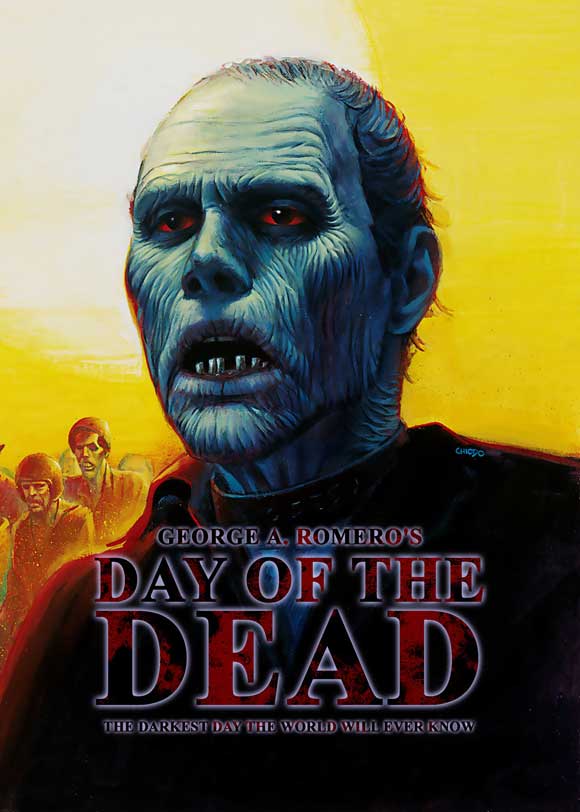
My contribution to Month of the living Dead over at Blood
Sucking Geek is an article for my favorite zombie film. Head over to read what
I have to say about it, and be sure get in on all of the zombie fun that’s taking place this month.
Labels:
George Romero,
Zombie
Friday, August 31, 2012
The Ghost / Lo spettro (1963)
‘Epic’ has sort of become a popular internet slang term
these days and is generally used as a descriptive response for anything that
comes off as grandly awesome. I normally prefer using it in the more
traditional sense as a tag for a long story that spans multiple books or movies.
So, even given its standard runtime, why is ‘epic’ the first adjective that
comes to mind when thinking about Riccardo
Freda’s generically titled Gothic horror/mystery THE GHOST?
In trying to come up with a possible answer, I find myself realizing just how well nearly everything about THE GHOST hits the spot. From the opening séance to the fulfilling ending, there ends up being a very attractive mental journey, dense with macabre elements, to a destination that could only be described as maniacal insanity, just before the film closes out with a religious representative reminding us that the devil is a very real person. I feel that it is this cadaverous journey, mostly within the confines of a richly decorated Scottish 1910 mansion as well as the grand supernatural, alien beauty of the film’s star, Barbara Steele, that merits the ‘epic’ tag.
Am I right when I say that Steele was an essential component in helping several Italian Gothics rise above being standard genre fare? Just like the chorus to a particular ‘80s Roxette song, she’s got the look. Here, Steele doesn’t portray her usual dual role of a good and an evil character but only the latter in this film, and it really is what she does best. She’s on fire in an immortal murder scene late in the movie that brings to mind the phrase ‘slashed to ribbons’.
In trying to come up with a possible answer, I find myself realizing just how well nearly everything about THE GHOST hits the spot. From the opening séance to the fulfilling ending, there ends up being a very attractive mental journey, dense with macabre elements, to a destination that could only be described as maniacal insanity, just before the film closes out with a religious representative reminding us that the devil is a very real person. I feel that it is this cadaverous journey, mostly within the confines of a richly decorated Scottish 1910 mansion as well as the grand supernatural, alien beauty of the film’s star, Barbara Steele, that merits the ‘epic’ tag.
Am I right when I say that Steele was an essential component in helping several Italian Gothics rise above being standard genre fare? Just like the chorus to a particular ‘80s Roxette song, she’s got the look. Here, Steele doesn’t portray her usual dual role of a good and an evil character but only the latter in this film, and it really is what she does best. She’s on fire in an immortal murder scene late in the movie that brings to mind the phrase ‘slashed to ribbons’.
Sunday, August 12, 2012
The Whisperer in Darkness (2011)
THE WHISPERER IN DARKNESS is one of the creepier and
tenser short stories from H.P. Lovecraft.
Readers are given enough hints to know all too well that something bad is going
on as the story’s protagonist, despite his academic intelligence, seems too
clueless and too stubbornly grounded in his notion of the realistic world to
realize that he’s heading to a perilous destination. Journeying along with this
character, Professor Albert Wilmarth, into an unnatural and creepy situation
written in a first person perspective is largely what I think makes this short
story work so well. In the first half there’s a lot of tension that is built up
from the letter exchange correspondence between Albert and another character,
Henry Akeley, whose farm is seemingly being invaded by alien monsters. However,
nothing really ends up being truly conclusive with a lot being left to suggestion
or just being the possible result of some weird and unexplainable phenomena or
coincidences.
While I don’t think that it reaches the same high tension found in Lovecraft’s original story, the film adaptation by The H.P. Lovecraft Historical Society (HPLHS) does an exceptional job at taking the liberty of filling in a lot of blanks by rounding out the story with much more definite events and including a third act that contains some new surprises that don’t disgrace the original story in the least. Though the narrative is understandably tweaked a bit to be more suitable for film, this still feels like one of the most faithful and near-perfect Lovecraft adaptations since the HPLHS’s CALL OF CTHULHU from 2005, though I honestly enjoyed THE WHISPERER IN DARKNESS a bit more.
Subscribe to:
Posts (Atom)


